
How archium® microsheets certify the authenticity of digital documents

The archium® microsheets represent a hybrid archiving solution that transfers digital documents into an analog, physical form to ensure their authenticity – that is, the guarantee of originality, integrity, and verifiability – over long periods. The certification of authenticity is achieved through the production of an unalterable, printed reference copy that serves as reliable proof. This is particularly relevant in areas such as archives, authorities, or companies where the genuineness of documents (e.g., contracts, certificates, or natively digital content) must be clearly proven. The process seamlessly connects digital metadata with analog storage and thereby creates an effective bridge between these two worlds.

The importance of faithfully reproducing the visual appearance of the digital document at the time of printing

A decisive component in certifying authenticity is the precise reproduction of the visual impression of the digital document exactly at the time of printing. archium® microsheets capture the document content as an image-like representation (e.g., from PDFs or other formats), which is printed raster-free and in high resolution (up to 22 line pairs per millimeter) on acid-free archival paper. This creates a “snapshot” of the document that authentically reproduces all visual elements – such as layout, fonts, colors, images, and structures – without losses or alterations due to compression or transformation.

This visual fidelity plays a central role because it:

  • Ensures immutability: The printed state is physically fixed and cannot be retroactively manipulated, unlike digital files that could be altered through software or attacks. Any subsequent digitization of the microsheet would reconstruct the exact visual impression from the time of printing.
  • Enables sensory verifiability: The visual impression is directly verifiable by humans (e.g., with a magnifying glass or scanner), allowing an intuitive authenticity check. In legal or archival contexts, this serves as proof that the document existed in this form at the time of printing – similar to a photographic image in forensics.
  • Provides protection against obsolescence: Digital formats can become unreadable due to software updates, but the visual print remains readable independently of technology and ensures that the original “look and feel” (including colors via the arCODECO method) is preserved for centuries.
  • Supports hybrid validation: The visual print can be compared with digital metadata to detect deviations, which strengthens the certification.

Without this visual reproduction, validation would be incomplete, as abstract data (e.g., text alone) could not fully capture the context and intention of the original. It makes the microsheet a reliable “witness” to authenticity.
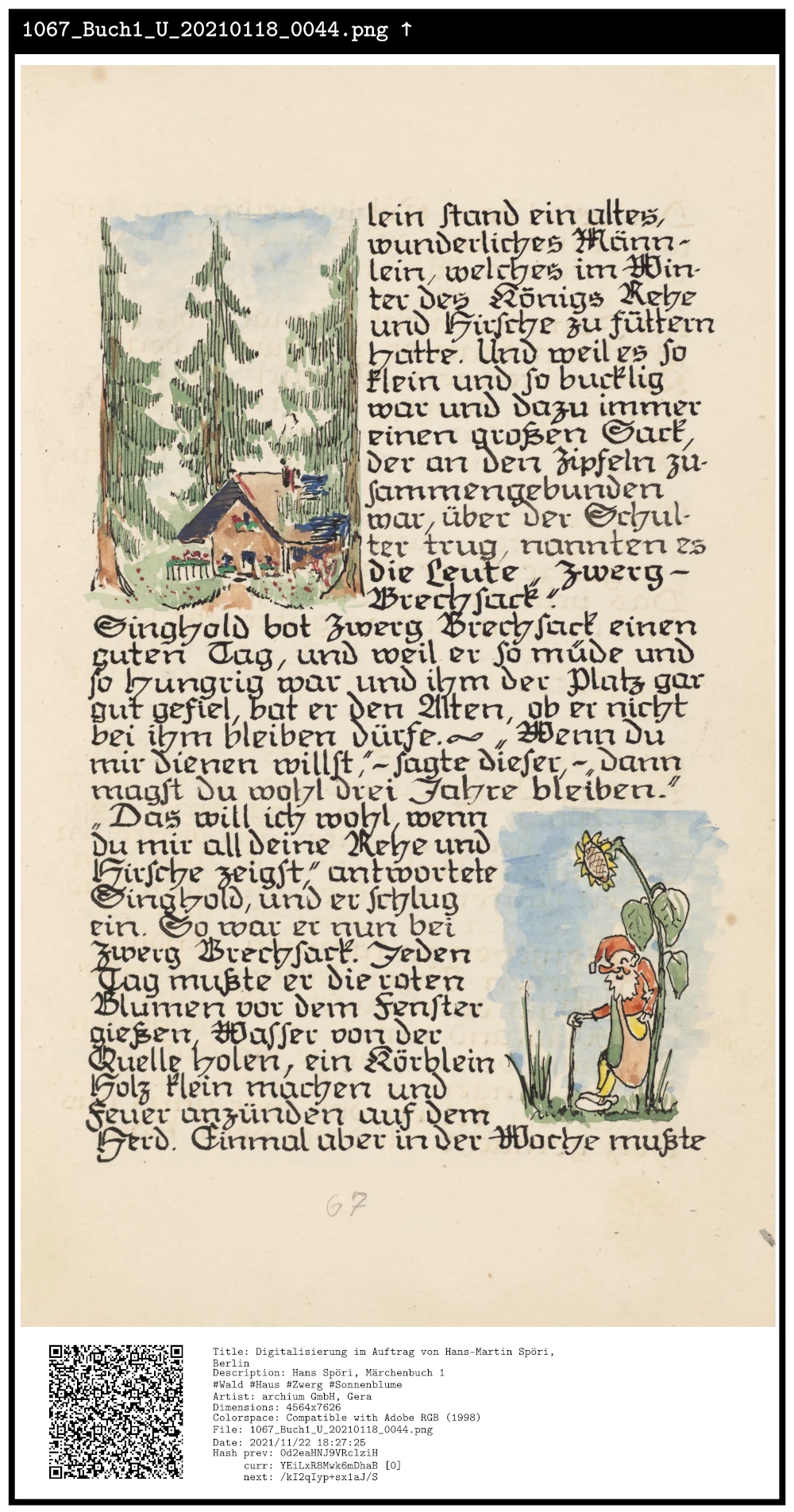
Proof of originality of a file through hash value comparison

The proof of originality can be achieved through the integration of hash values, which serve as a cryptographic fingerprint of the file. A hash value (e.g., SHA-256) is a unique string generated from the content of a file. Any change to the document alters the hash. archium® microsheets can extend this mechanism by printing the hash value directly under the printed document (e.g., in the QR code or as readable text). The process works as follows:

  • Generation of the hash value: Before printing, the hash of the digital file (including all visual elements) is calculated. This takes place in the arTUX archive database from archium®, where the file is structured and prepared.
  • Printing on the microsheet: The hash value is printed on the paper together with the visual content – ideally in a QR code for machine readability or as an alphanumeric string for human verification. The QR code, which already contains metadata, can be extended to embed the hash.
  • Proof through comparison: To prove originality:
  1. Digitize the microsheet (e.g., with a scanner or smartphone).
  2. Calculate the hash of the digitized file.
  3. Compare this new hash with the hash printed on the microsheet.
  4. If they match, the file is original and unchanged since the time of printing. Deviations indicate manipulation.

This solution is robust because:

  • The printed hash is physically immutable and serves as a reference.
  • It is stored independently of digital systems.
  • It complements the visual reproduction: The hash confirms not only the content but also that the visual impression is authentic.

Through this comparison, originality is cryptographically proven, making microsheets a secure instrument for certification.

Icon Urkunde

Certification

archium®microsheets enable the certification of the authenticity of digital documents through visual fidelity, hash comparisons, and blockchain integration of the metadata of a digital collection.
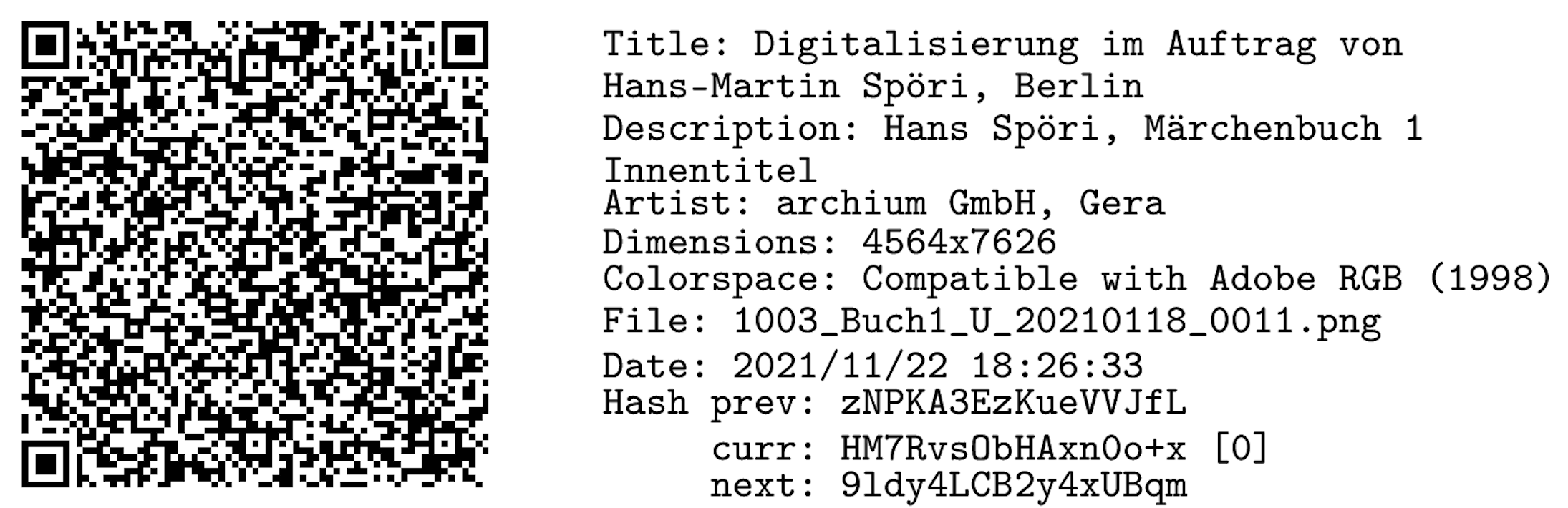
QR-Code und Metadaten

Authenticity verification of the entire holdings using blockchain technology

Authenticity verification of the entire printed holdings (e.g., an archive or a collection of microsheets) is performed using blockchain technology by summarizing and printing hash values.

  • Summarization of hash values: For each individual hash (per document), a hash chain is created that summarizes all hashes of the holdings in a root hash. This root hash cryptographically represents the entire holdings.
  • Integration into the blockchain: The root hash is stored in a blockchain as a transaction. Each transaction contains the hash, a timestamp, and the metadata stored in the QR code. The blockchain ensures that the hash is immutable and verifiable – manipulations would be immediately detectable because the blocks are chained.
back