
Requirements for long-term archiving of digital and digitized documents

Long-term archiving (LTA) of digital documents aims to preserve archivally valuable information over unlimited or legally required periods, keeping it accessible and maintaining its integrity. It must ensure that data remains available, readable, true to the original, and unaltered at all times, regardless of technological changes.

Important requirements for long-term archiving include:
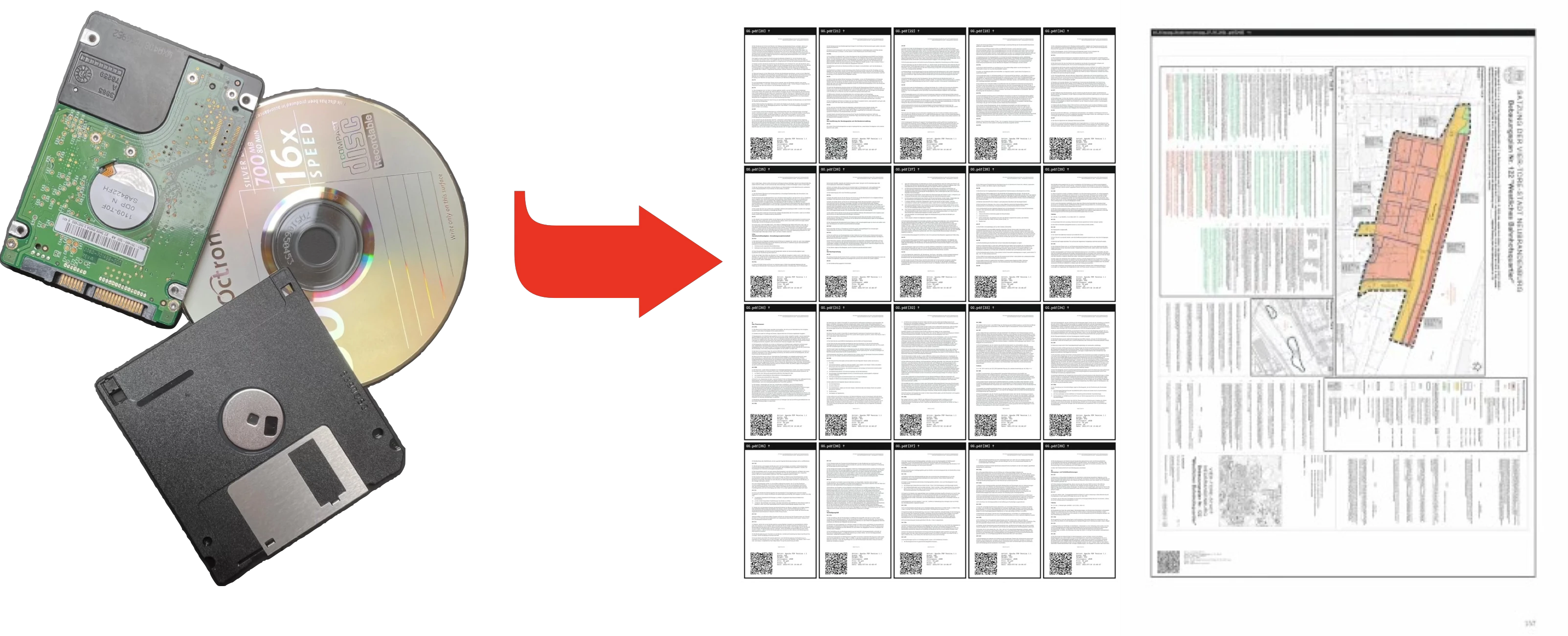
  • Availability and accessibility: Data must be retrievable at any time over long periods (across generations), even considering future technologies.
  • Readability and interpretability: Open, standardized formats (e.g., PDF/A) should ensure that content remains readable for decades without proprietary software.
  • Fidelity to the original and protection against falsification: Elaborate mechanisms such as data verification, error correction, and immutable storage should prevent manipulation and ensure integrity.
  • Longevity and durability: Storage media must be resistant to aging. Regular checks and redundancy protect against loss.
  • Security: Encryption, access controls, and protection against cyber threats, physical damage, or environmental influences are essential.
  • Metadata management: Comprehensive metadata facilitates search, identification, and long-term management.
  • Sustainability and cost efficiency: Archiving should be resource-efficient, without high ongoing costs for energy or migration.

These requirements make long-term archiving (LTA) a challenge, as purely digital systems are vulnerable to obsolescence, energy dependence, and attacks. This is where hybrid solutions like archium®microsheets come into play, combining analog and digital elements.

Why archium® microsheets are ideal for long-term archiving

archium® microsheets are a hybrid archiving solution that converts digital data into analog form on acid-free archival paper, enabling durability of over 300 years. They are particularly suitable for archives because they meet the aforementioned requirements and offer advantages over purely digital media.

  • High durability and longevity: microsheets use paper according to DIN ISO 9706, which is durable for at least 200–300 years, in contrast to digital media that can fail abruptly. The degradation is gradual and announces itself, allowing timely measures – a key requirement of long-term archiving for long-term availability. They protect against data loss due to decay of original documents or digital born-digital content and normalize large formats (e.g., >A0) to uniform, compact sheets.
  • Independence from technology, electricity, and internet: A central strength is energy independence: microsheets require no electricity, software, or internet for access, making them robust against failures. Contents are readable with simple means (e.g., magnifying glass, office scanner, smartphone), ensuring readability over centuries without relying on obsolete technologies – in contrast to digital systems that require migrations. This meets the LTA requirement for future accessibility.
  • Protection against cyber attacks and manipulation: As an analog medium, microsheets offer inherent protection against cyber threats, manipulation, deletion, or encryption, as they have no digital attack surface. They serve as backup in hybrid systems, creating redundancy and ensuring fidelity to the original. QR codes integrate metadata for quick identification and automated read-back, without compromising security.
  • Hybrid integration and compatibility with digital systems: Hybrid archiving combines digital storage (e.g., in the arTUX database) with analog backup, making documents redundantly available. Digital data is converted into image-like PDFs, miniaturized, and printed, enabling loss-free, color reproduction. This meets metadata requirements and facilitates integration into digital workflows, while the analog component provides independence.
  • Space and cost efficiency as well as environmental friendliness: microsheets save enormous space (96% compared to conventional folder storage) and costs (up to 75% of the costs of a new archive building). They are recyclable, contain no hazardous waste, and require no rare earths, increasing sustainability – an important addition to LTA requirements.

archium®microsheets meet all requirements for long-term archiving through their analog-digital hybrid nature, high durability, and independence, while minimizing the risks of purely digital systems and thus providing long-term security.

back