microsheets as secondary preservation for securing analog originals

archium® microsheets serve as an innovative hybrid solution for secondary preservation in archives, by reproducing analog originals (e.g., historical documents, certificates, plans, or photographs) in a miniaturized, high-resolution, and colored form on acid-free archival paper (according to DIN ISO 9706). As secondary preservation, they act as a redundant, analog copy that protects the originals by handling daily access and use, while the primary objects are stored securely. The process involves digitizing the originals, structuring them in archium®’s arTUX archive database, and subsequently printing them on microsheets. These highly miniaturized sheets offer durability of over 300 years, are independent of energy supply, and resistant to cyber threats, making them a robust complement to digital systems.

Completing incomplete collections

microsheets enable the completion of incomplete collections by reconstructing or supplementing missing or damaged originals. Analog originals that are incomplete due to aging, wars, or environmental influences can be brought together as a coherent secondary preservation through digitization and printing on microsheets. For example, in historical archives like the Cologne City Archive, which suffered damage from the collapse in 2009, microsheets could have served as a stable supplement. Damaged documents are scanned, missing parts integrated from alternative sources (e.g., copies or related collections), and printed as a uniform microsheet collection. The high storage density (up to 20,000 pages on 500 sheets, three times higher than microfilm) allows the compilation of large volumes in compact space, completing the collection without physical expansion. Metadata in QR codes under each file facilitate tracking of supplements, ensuring the collection remains scientifically traceable. This not only promotes integrity but also usability for researchers, who receive a complete overview without burdening the originals.

Decentralized storage

Decentralized storage is enabled by the compactness and independence of microsheets, which minimizes risks and increases security. Instead of storing all originals centrally – which is vulnerable to disasters such as fire, flooding, or theft – the archium® microsheets as secondary preservation can be distributed across multiple locations. One shelf-kilometer of originals corresponds to only two Euro pallets with microsheets (each 180 boxes à 28,000 pages), facilitating transport and distribution. For example, state archives could store copies in regional depots or even internationally to hedge against geopolitical risks. The sheets require no special conditions (no cooling, electricity, or humidity control), making decentralized locations in normal rooms possible. In crisis situations (e.g., blackout), access remains available because microsheets are readable with simple means. This creates redundancy and resilience, while the originals remain at a secure primary location.

Use copies, particularly for cumbersome or deteriorating architectural drawings

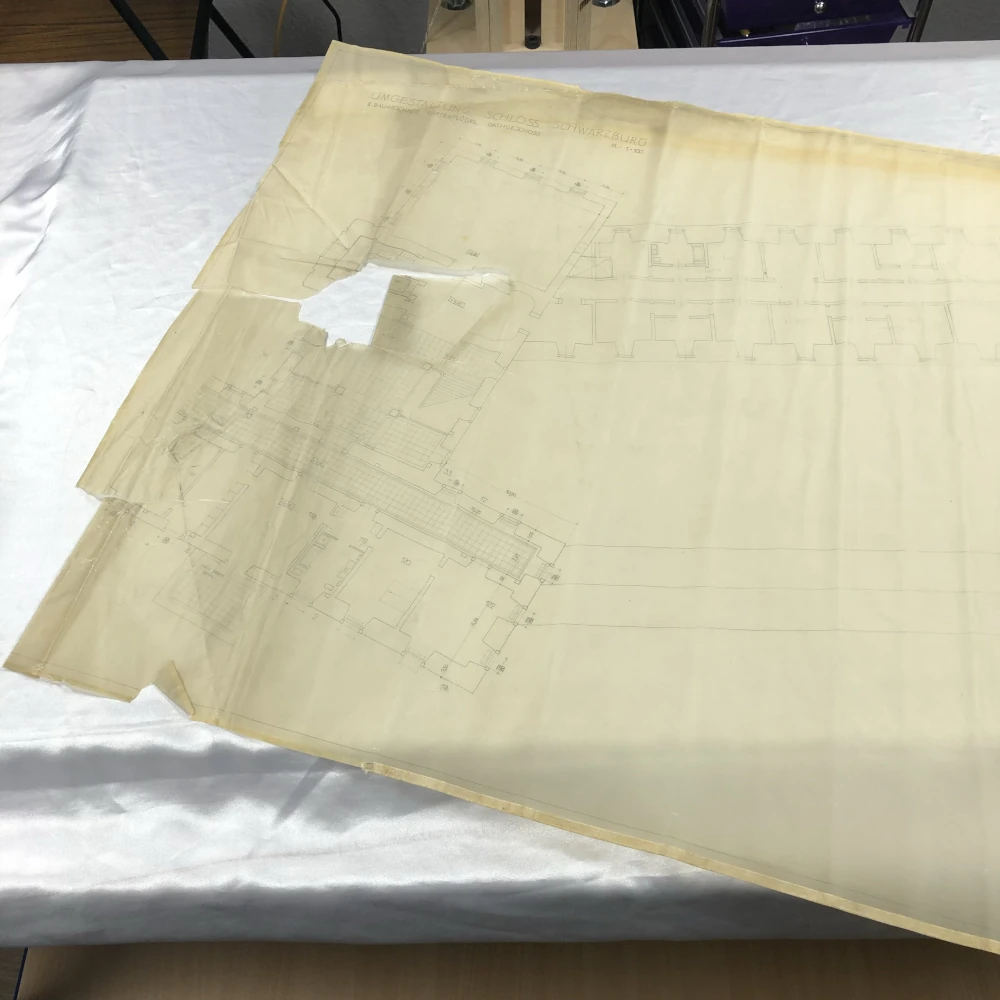
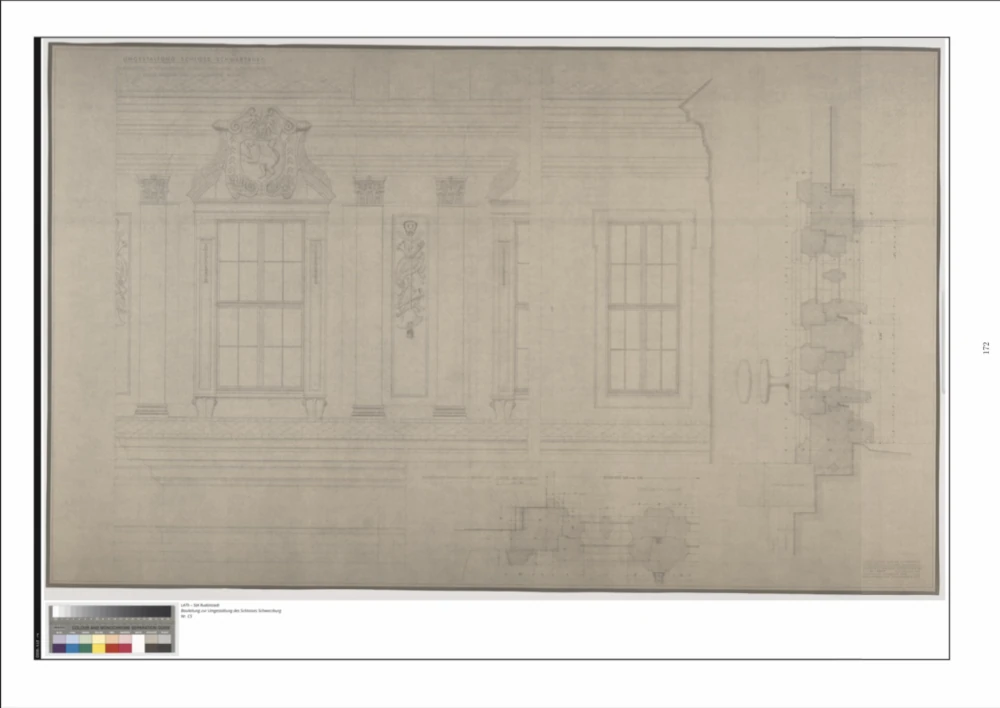
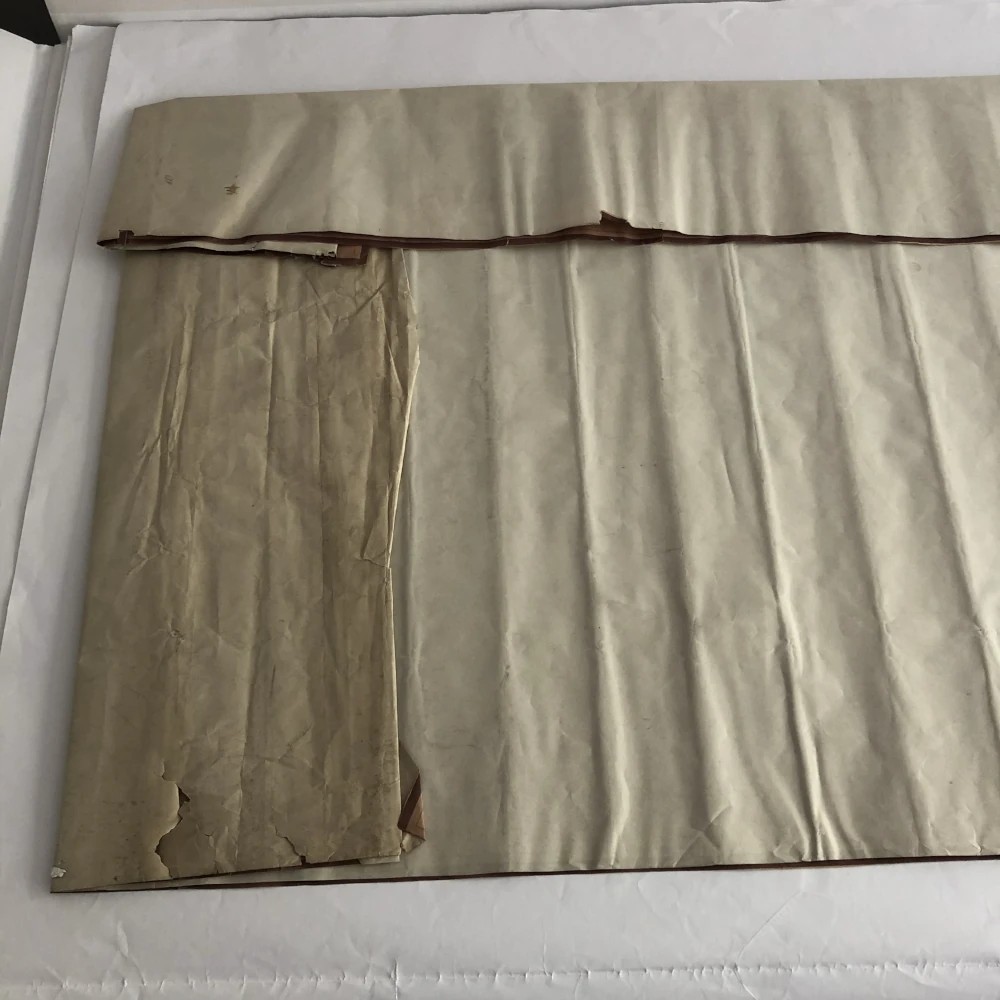
microsheets are excellently suited as use copies, i.e., as practical derivatives of the originals for daily use, without endangering the primary objects. Particularly for cumbersome or deteriorating architectural drawings (>A0 format), they offer a solution: Large plans are normalized and miniaturized, printed on A3 sheets, while the high resolution (raster-free, up to 22 line pairs per millimeter) preserves all details. Deteriorating originals that become brittle due to aging remain untouched, while the microsheets serve as derivatives for architects, historians, or authorities. Users can scan and scale the sheets to enlarge them digitally, facilitating handling. This avoids physical wear and enables mobile use, e.g., on construction sites. In archives like the Duchess Anna Amalia Library in Weimar, fragile maps and plans could have been duplicated and preserved in this way before the major fire in 2004.

Deteriorating architectural drawing

Defective architectural drawing

A0 construction plan (original) miniaturized to A3 format (use copy)

Avoiding media discontinuity in the archive after switching to digital document storage

Switching to digital storage risks a media discontinuity – that is, a break in continuity between analog originals and digital systems, leading to incompatibilities, losses, or dependencies. microsheets avoid this by creating a hybrid bridge: Analog originals are digitized and simultaneously printed as an analog secondary preservation, ensuring the archive holdings exist redundantly in both worlds. This guarantees continuity: Digital systems provide fast access, while microsheets ensure independence from technology (no obsolescence, migrations, or power dependence). During a switch, analog workflows are preserved, e.g., through physical sheets referenced in digital databases. Metadata in QR codes seamlessly connect the media, preventing any discontinuity – for example, a digital search system leads directly to a microsheet file. This protects against data loss from cyber attacks or system failures and preserves authenticity, as the analog form remains sensorially verifiable.

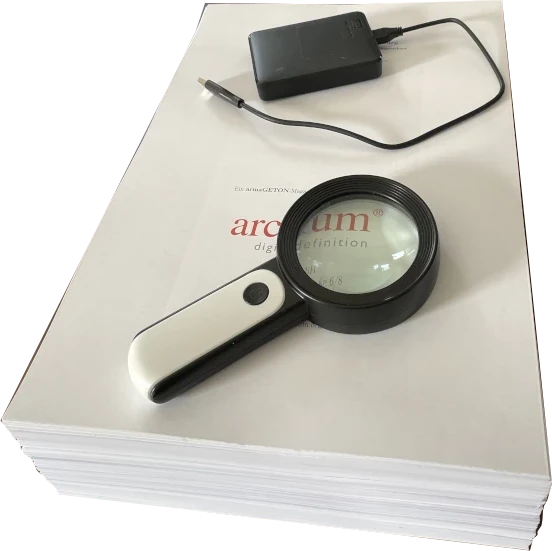
672 historical architectural drawings

are hidden in this small stack. The originals occupy an entire room and are gradually deteriorating. The prints on acid-free archival paper will very likely outlast both the originals and the digital copies.

Securing the profession of the archivist through management of analog storage media

microsheets secure the profession of the archivist by preserving and expanding expertise in handling analog storage media. In a digitized world, traditional skills are at risk of being lost, yet microsheets continue to require analog management: sorting, storage, cataloging, and physical inspection of the sheets. Archivists can apply their core competencies (e.g., provenance verification, conservation) to these new carriers while managing hybrid systems. The gradual degradation of the sheets allows proactive measures, positioning the archivist as guardian of longevity. Furthermore, this promotes continuing education in hybrid methods, making the profession more attractive and protecting it from automation. In institutions, the archivist remains central, as microsheets require human interpretation – for example, in manual reading with magnifying glasses or integration into work processes.

Further advantages and applications

In addition, microsheets have further properties:

  • Protection against external threats: As secondary preservation, microsheets provide resilience against cyber attacks, blackouts, or EMP events, as they are independent of technology. Originals remain secure, while microsheets handle daily use.
  • Cost savings and sustainability: microsheets are inexpensive (from 0.06 € per miniaturized document page), and storage saves space (96% reduction). The paper is recyclable, without harmful substances, promoting environmental protection.
  • Research and public outreach: microsheets facilitate access for users, e.g., through mobile copies, and support exhibitions without risk to originals.
  • Legal and ethical aspects: They ensure authenticity through visual fidelity, metadata, and hash value verification, which helps in court or inheritance matters.

In summary, archium® microsheets make secondary preservation a versatile strategy that protects analog originals, modernizes archives, and provides long-term security.

back