
Hybrid archiving with microsheets as a backup solution

archium® microsheets are an innovative technology for the long-term archiving and backup of digital data, developed by the company archium®. They are based on a hybrid archiving method that combines digital and analog storage to protect data from loss due to technical failures, cyber attacks, or the aging of digital media. At their core, digital data is converted into an analog form and printed in high resolution on acid-free paper, enabling durability of over 300 years in the smallest possible space. This makes microsheets a robust backup option that functions independently of electricity, the internet, or special hardware. The technology is particularly suitable for sensitive data such as documents, images, or archives that need to be preserved long-term without relying on expensive or vulnerable digital storage media.

In contrast to conventional digital backups (e.g., on hard drives, in the cloud, or on tapes), which are susceptible to hardware failures, ransomware, or obsolescence, microsheets  offer an energy-independent, physical alternative. They use a printing technique inspired by microfilm but implemented on sheets (microsheets), which enables higher storage density and easier handling. Up to 20,000 pages can be stored on just 500 sheets, corresponding to a density approximately three times that of traditional microfilm. The standard size is DIN A4, but DIN A3 and other formats are also possible. Color prints can additionally be realized in monochrome using the arCODECO method, which sequentially maps and reconstructs RGB and CMYK channels to preserve authentic color information.

Hybrid archiving

archium® offers you a unique process that seamlessly combines the advantages of digital storage with the security of analog long-term archiving.

A central component of microsheets is the integration of QR codes, which provide metadata and facilitate their use as a full-fledged backup.

The process of data storage on microsheets

The conversion of digital data into an analog backup on microsheets  takes place in several steps that ensure a seamless integration of digital and analog:

  1. Preparation of digital data: First, the digital contents (e.g., documents, images, PDFs, or other files) are converted into an image-like form. Vectorized letters and graphics are advantageous here, as they enable high quality during scaling. The converted templates are saved as PDFs to ensure a uniform format. This facilitates later migrations and ensures that the data remain readable independently of software versions.
  2. Digital archiving as the basis: The prepared data is digitally captured and archived in the arTUX archive database from archium®. This creates a primary digital copy that can be used for daily access.
  3. Conversion to analog form: The digital images and documents are transferred to acid-free paper. a​rchium® uses a specialized printing technique that enables pixel-perfect image reproduction. The microsheets can be printed in grayscale or color. The print resolution is raster-free, ensuring high quality reproduction. This highlights a key advantage of hybrid archiving: It protects the data from cyber attacks and technical failures by establishing analog storage as an additional, independent backup that is durable for over 300 years.
  4. Integration of metadata: A QR code is placed under each printed file, containing metadata. This metadata includes information such as file name, creation date, content description, or access rights. The QR code serves as a bridge between the analog and digital world and enables quick identification of the contents. Additionally, metadata is printed in plain text to ensure completely technology-independent access.
  5. Physical storage: The finished microsheets are stored in a secure environment. They require no special conditions such as cooling or electricity, are recyclable, and contain no rare earth elements or hazardous substances. The gradual nature of degradation (in contrast to sudden data loss in digital media) provides advance warning if renewal is necessary.
  6. Use in the archive: As long as you have access to your arTUX archive database or other archive software, regular use is not intended. However, in the event of data loss, you can quickly restore individual documents or entire archives from the archium®microsheets backup. Each individual archive box is equipped with a table of contents and keyword index and can be used completely independently of technology, like an encyclopedia.

Through this process, microsheets become a full-fledged backup that functions as a protection mechanism and secures data for generations.

The use of QR codes in detail

QR codes play a decisive role in using archium microsheets as a backup. They are not just an addition but an integral part of hybrid archiving:

  • Function as metadata carrier: Each QR code contains encoded metadata for the underlying file. When scanned with a smartphone or scanner, you immediately gain access to details such as file structure, content type, or original source. From the metadata, a table of contents and keyword index are generated before printing. This greatly facilitates later navigation through large archives without having to manually search through all the sheets.
  • Enabling data recovery: In the event of digital data loss (e.g., due to a hacker attack or hardware failure), the QR codes serve as the entry point for recovery. You scan the code to extract the metadata and can then digitize the printed file. Based on the unique metadata assignment, documents can later be automatically reassembled in the correct order. This makes microsheets a “full backup,” as they contain not only the raw data but also contextual information, and the read-back process is automatable.
  • Simple readability and integration: QR codes can be read with common tools – a smartphone is sufficient. They optimize data preparation by combining images with metadata and enabling pixel-perfect reproduction. In hybrid archiving, they ensure that the analog part is seamlessly connected to the digital part.
  • Advantages in practice: QR codes make microsheets user-friendly. Instead of specialized reading devices (as with microfilm), a simple scan is sufficient to retrieve document contents and metadata. In the event of technology failure, all information remains accessible with the simplest means, such as a magnifying glass.

Backup

The QR code stores the metadata and enables automated re-digitization from paper.
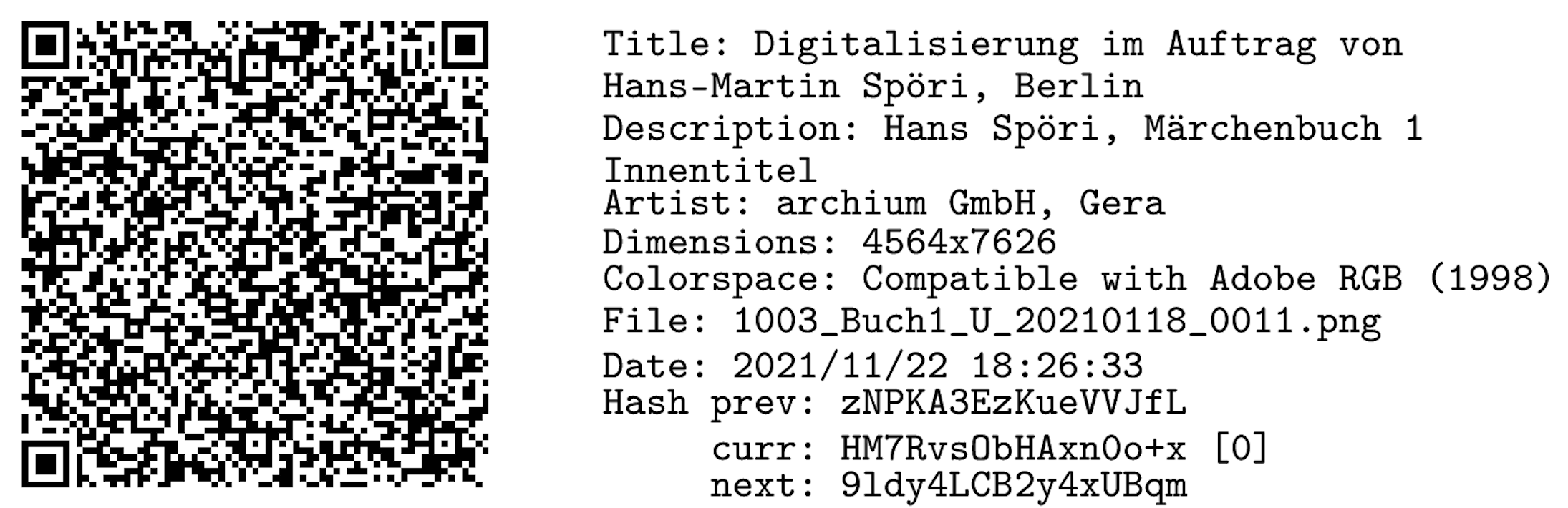
QR-Code mit Metadaten

Hybrid archiving and advantages as backup

The hybrid archiving from archium® combines digital storage (for fast access) with analog (for longevity). Digital files are printed in parallel on microsheets, creating redundancy. In contrast to purely digital systems, this reduces dependence on technology that can fail. The microsheets serve as a complete backup: In case of loss of the digital version, the analog files can be scanned and reconstructed.
Advantages:

  • Durability: Over 300 years, resistant to cyber threats..
  • Independence: No electricity or internet required.
  • Cost efficiency: High storage density, simple storage.
  • Recovery: Simple digitization with office equipment.
  • Environmental friendliness: Recyclable, free of harmful substances.
Zurück